
Diesel Generator for Data Center: Backup Power Design Guide
A data center backup generator is sized from the real IT load plus future growth, configured in N+1 or N+2 redundancy, paired with a UPS that bridges the start-up gap, switched by a correctly rated ATS, and proven by full-load testing — not by nameplate math. Get these five steps right and the facility stays online through any outage.
SummaryDesigning diesel backup power for a data center is about redundancy and coordination, not just buying a big generator. This guide walks through sizing from IT load, N+1/N+2 architecture, UPS and generator interaction, ATS transfer, fuel runtime, and the load testing that proves the whole system works.
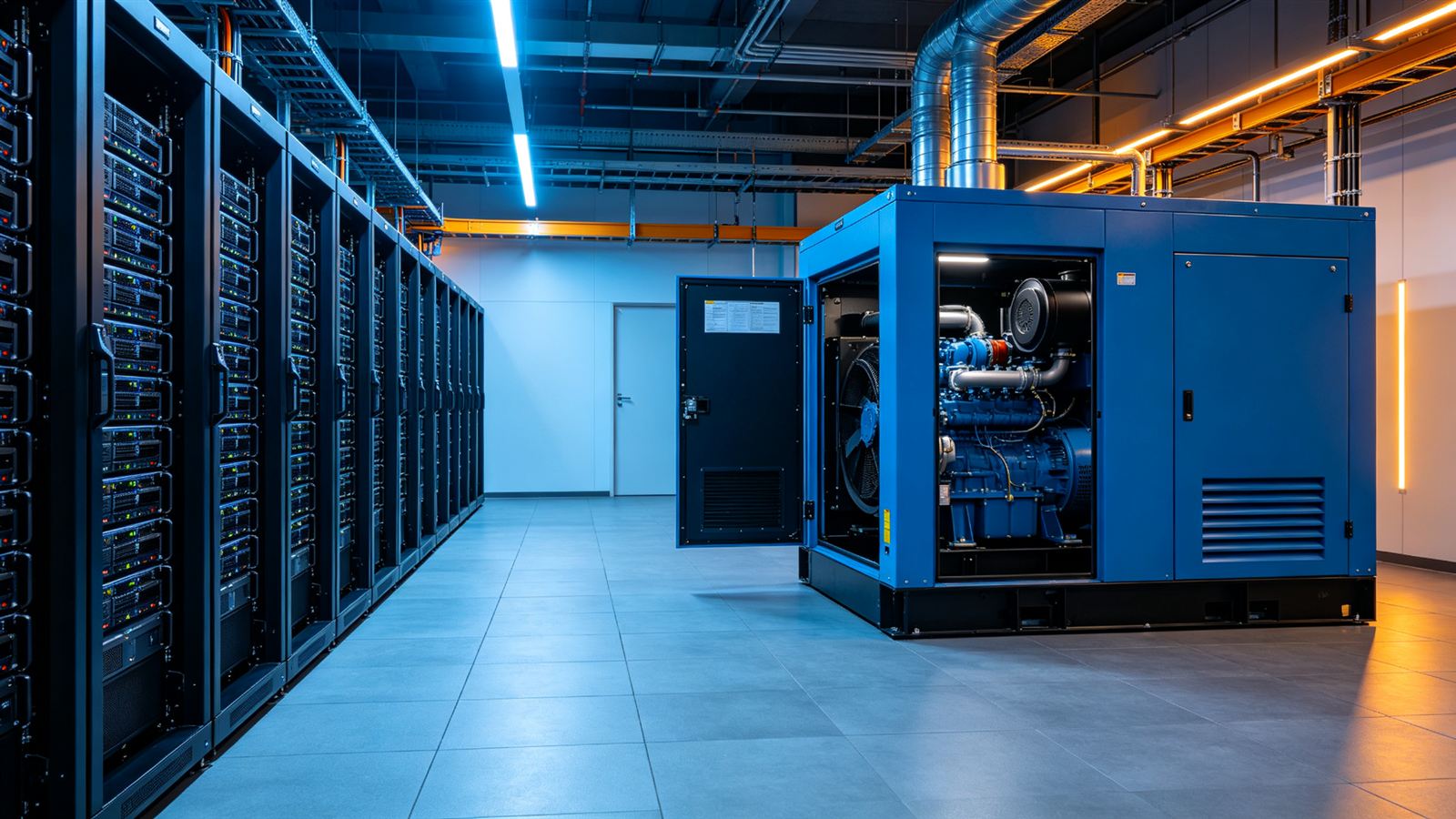
Why a Data Center Needs Diesel Backup Power
A modern data center is an around-the-clock consumer of electricity, and downtime is measured in money lost per minute. The industry solves this with a layered architecture: utility power feeds the building, a UPS (uninterruptible power supply) covers the first seconds of any interruption, and a diesel generator set carries the load for the hours or days the outage lasts. The generator is the long-duration safety net — without it, a UPS alone can only keep the facility alive for minutes.
As GPU-heavy AI workloads push rack densities higher, both the connected load and the appetite for reliable backup grow. The diesel generator remains the standard, field-proven answer because it delivers full rated power within seconds, runs for days on stored fuel, and is independent of the grid.
Step 1: Size from the IT Load, Not the Nameplate
The most common mistake is sizing a backup set from the building's connected capacity. The correct starting point is the load the generator must actually carry when the utility fails. Work from these numbers:
- Real IT load — the actual operating draw of servers, switches, storage and cooling that must stay up, measured in kW.
- Power factor — generator ratings are given in kVA at 0.8 power factor; convert kW to kVA with kW ÷ 0.8.
- Future growth — size for the IT load you expect in 3–5 years, typically +20–30%, so the set is not obsolete on day one.
- Start-up surge — motors in cooling compressors and pumps draw several times their running current on start; the generator must hold voltage under this transient.
- Non-IT loads — lighting, fire systems, lifts and ancillary equipment that must also run in an outage.
Because a data center generator runs only in emergencies, it is almost always specified at standby (ESP) rating — built for short, reliable outages rather than continuous prime duty. A larger prime-rated set is only needed when the facility runs on generator power for long, planned periods.
| Design Input | Typical Value | Why It Matters |
|---|---|---|
| Actual IT load | e.g. 800 kW | The real load the set must carry |
| kVA conversion | 800 ÷ 0.8 = 1000 kVA | Generator ratings are in kVA |
| Future growth | +25% = 1250 kVA | Avoids early re-specification |
| Standby rating | 1250 kVA ESP | Matched to emergency duty |
Step 2: Build in Redundancy (N+1 / N+2)
Redundancy is the architecture that turns one generator into a dependable system. N is the number of units needed to carry the full load. N+1 means one additional unit runs as a spare, so a single machine can fail, be serviced, or be taken offline for maintenance without the facility losing power. N+2 adds a second spare for higher availability tiers.
Practical redundancy designs used in data centers:
- 1 + 1 parallel — two equal sets, one running, one spare; capacity equals one set.
- 2 + 1 parallel — three sets where any two carry the load; the third is spare.
- 2 + 2 — four sets, two of which must fail before capacity drops — common in Tier IV facilities.
Parallel sets are controlled by a paralleling system (a generator controller with synchronization) that starts units on load demand, shares the load evenly, and steps units on and off. This is standard on Lucency sets sized for data centers, which support true isochronous load sharing and bus-paralleling.
Step 3: Match the UPS and the Generator
The UPS covers the gap between the grid failing and the generator reaching stable power. A typical diesel set starts and accepts load in 10–15 seconds; the UPS bridges those seconds without a blip. But the two systems must be coordinated or they fight each other:
- Start signal — the ATS or the UPS sends a remote start command to the generator the instant the utility drops.
- Load transfer — the generator must be up to speed and stable before the ATS transfers the load; transferring early can stall a cold engine under sudden load.
- Harmonic behaviour — rectifier loads from UPS systems inject harmonics; the generator alternator should be specified with a low reactance and a broad overload capability to hold stable voltage and frequency.
Step 4: Choose the Right ATS Transfer
The automatic transfer switch (ATS) is what actually moves the load between utility and generator. For data centers the key decisions are:
- Type — closed transition (make-before-break) allows a seamless transfer with no power gap for the IT load; open transition (break-before-make) is simpler but introduces a brief interruption covered by the UPS.
- Rating — the ATS must be rated for the full standby load, including the inrush of the load bank and cooling motors, with the right breaking capacity.
- Fast re-transfer — when the utility returns, allow a stabilization period before switching back, so a flickering grid does not slam the load on and off the generator.
Medium- and large-capacity facilities increasingly use paralleling switchgear instead of a single ATS, so several generators and multiple utility feeds combine into one distribution bus. This is where the 2000 kVA range and above, with automatic synchronization, is a genuine advantage.
Step 5: Plan Fuel and Runtime
Backup power is only as good as its fuel plan. A 1250 kVA set at full load burns roughly 250–300 liters of diesel per hour. Data center operators typically keep on-site storage for 24–72 hours of continuous running, with a refuelling contract standing by for longer outages.
- Tank capacity — match day tanks to the required runtime; for 48 hours you need roughly 12,000–14,000 liters for a 1250 kVA set.
- Fuel management — use a day tank plus a bulk storage tank, with automatic transfer so the generator always draws from a full supply.
- Fuel quality — add a fuel polishing system so stored diesel stays clean; stale or contaminated fuel is a leading cause of generator no-start in an emergency.
Load Testing: The Only Way to Prove Protection
A backup system that is never exercised will fail when it matters. Data center best practice calls for full-load testing — usually monthly at part load and a full rated load test every quarter or annually, often using a portable load bank:
- Runs the engine under real heat and load to reveal cooling and fuel issues.
- Exercises the ATS, UPS interaction and paralleling logic under stress.
- Verifies the set reaches full rated output, not just the nameplate claim.
Generator Options for Data Center Sites
Data centers house their backup sets in dedicated plant rooms or outdoor enclosures. The two common configurations are:
- Silent / canopied sets — a soundproof canopy for rooftop or plant-room installations where noise matters; available from small to 2000 kVA.
- Containerized sets — a complete weatherproof power station with the generator, fuel tank, controller and switchgear pre-integrated in a shipping container, ideal for modular and rapid deployments, and for multi-megawatt paralleled installations.
For expansion, parallel-capable units let you add capacity without replacing what is installed — size each set now, then grow the bus as the IT load climbs.
How Lucency Configures Data Center Sets
When a project is a data center, we engineer the set around availability rather than price:
- Standby (ESP) rating matched to the IT load with future growth.
- Low-reactance alternators and deep overload capacity for UPS harmonic behaviour.
- Parallel-ready controllers with auto-synchronization and load sharing for N+1 / N+2.
- ATS-ready interfaces, remote start terminals and alarm reporting to the building management system.
- Factory full-load testing, with documentation you can hand to your consultant.
Frequently Asked Questions
Send us your IT load, site conditions and redundancy target — we configure parallel-capable, ATS-ready generator sets with the right rating and testing.