
HFO Generator Guide: When Heavy Fuel Oil Power Makes Sense
An HFO (heavy fuel oil) generator earns its place in large prime and continuous-duty plants where the set runs many hours a week and bulk fuel storage is available. It is cheaper per kWh at high running hours, but it costs more upfront, needs heated and conditioned fuel, and takes more space. For small loads, standby-only duty, or tight emissions rules, diesel or natural gas is usually the better fit.
SummaryHeavy fuel oil is a low-cost residual fuel favored by mining, oil & gas, island mini-grids and large industrial plants that need continuous power far from the grid. This guide explains how HFO generators work, where they win, how they compare with diesel and natural gas, and the fuel-treatment and permitting questions you must answer before specifying one.
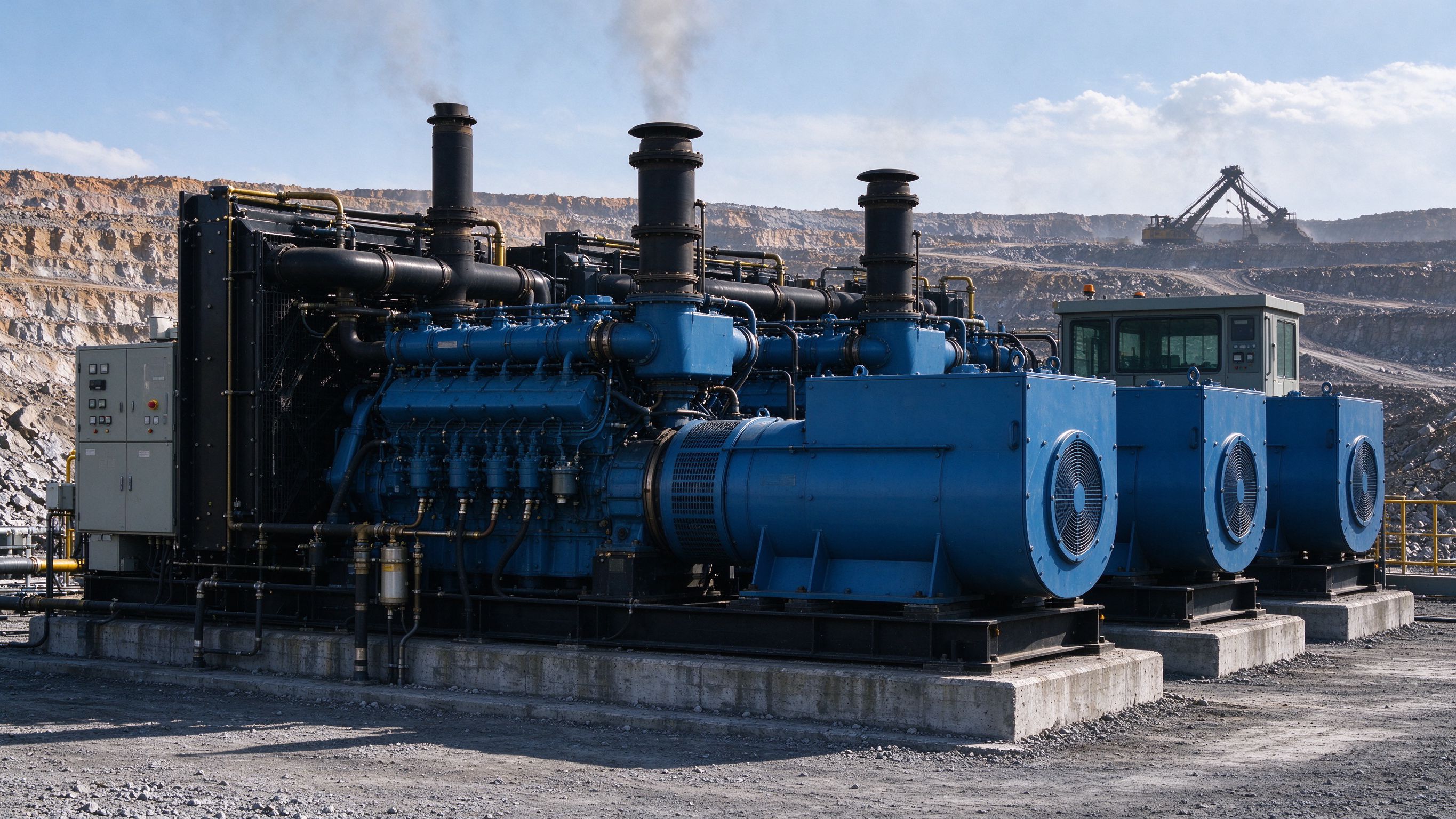
What Is an HFO Generator?
An HFO generator runs on heavy fuel oil — a dense, residual fuel left over after crude oil refining, often traded as marine-grade HFO or RMG 380. Because HFO is cheaper per unit of energy than diesel, large gensets burning it are used mainly for prime power and continuous-duty service, where fuel volume over the plant's life is large enough to matter.
HFO units are typically medium- or slow-speed engines built in the larger output bands, roughly from 1,000 kVA upward. They are supplied as single high-output sets or as multi-engine power plants that share a control and synchronizing system.
How HFO Differs from Diesel
Diesel is a light, refined fuel that burns in a standard high-speed engine with straightforward storage. HFO, by contrast, is thick and waxy at ambient temperature. Before it can be injected, it must be heated to bring down its viscosity, then separated, filtered and conditioned through a dedicated treatment loop. That fuel system — settling and day tanks, heaters, centrifuges, fine filters and circulating pumps — is part of the engineered package rather than an optional accessory.
Why HFO Wins on Fuel Cost at High Running Hours
The economic case is built on running hours. In standby duty a set may run only tens of hours a year, so a cheaper fuel rarely changes the budget. In prime or continuous service — running 12 to 24 hours a day, six or seven days a week — fuel becomes the largest cost over the plant's life, and HFO's lower price per unit energy can offset the higher capital cost and extra fuel-system complexity over several years of operation.
Where HFO Generators Fit Best
HFO is not a general-purpose fuel for every site. It earns its keep at locations that combine a large load, high annual running hours, room for bulk storage, and access to HFO supply.
Mining and Heavy Industry
Open-pit mines, mineral processing plants and quarries often operate far from the grid for years at a time. A reliable HFO prime power plant running on locally stocked fuel keeps crushers, conveyors, dewatering pumps and workshops online, and can be staged as additional engines join the load.
Oil & Gas and Onshore Facilities
Pump stations, compressor stations, well-processing plants and remote logistics bases need continuous power close to their own fuel logistics. HFO plants can be tied into site bulk storage and expanded in modules as the field or facility develops.
Islands and Remote Mini-Grids
Communities and industries on islands or in remote regions where extending the utility grid is uneconomical often run their local mini-grid on heavy fuel oil. The fuel ships in bulk, lowers the per-kWh generation cost compared with diesel, and the plant can carry both residential and commercial load.
Large Industrial and Emergency Power Plants
Manufacturing campuses, desalination and water-treatment plants, and large standby or emergency plants that can justify the space and fuel-treatment hardware may specify HFO for the main duty, with smaller diesel sets reserved for black-start or backup support.
HFO vs Diesel vs Natural Gas
The three fuels fit different duties. Use the comparison below as a first filter, then size the plant against your connected load and site conditions.
| Factor | HFO Generator | Diesel Generator | Natural Gas Generator |
|---|---|---|---|
| Best duty | Prime / continuous, high hours | Standby or prime, flexible | Prime where gas supply is stable |
| Fuel cost per kWh | Lowest in bulk HFO markets | Medium | Low to medium with pipeline gas |
| Upfront plant cost | Highest (engine + treatment loop) | Lower | Medium to high |
| Fuel storage | Bulk tanks plus heating and conditioning | Simple tank, stores for months | Pipeline gas or LPG storage |
| Footprint and install | Largest, dedicated room required | Compact | Medium |
| Emissions and handling | Higher SOx and particulates; treatment needed | Lower than HFO | Cleanest of the three |
| Typical output band | Around 1 MVA and up | 10 kVA to several MVA | Broad range |
Fuel Treatment and Storage You Must Plan For
A credible HFO quotation should describe the fuel treatment loop and how it interfaces with site tanks. Expect settling and day tanks, preheaters, centrifuges or separators, fine filters, a circulating return line, and controls that protect the engine from cold, viscous or contaminated fuel. Without this loop, HFO cannot be burned reliably over long hours.
When HFO Is Not the Right Choice
HFO does not suit small loads, intermittent standby duty, sites with limited floor space, or locations with strict sulfur and particulate limits that would require scrubbers or treatment your team cannot maintain. If your annual runtime is low, fuel storage is tight, or local emissions rules are restrictive, a diesel or natural gas generator is usually the simpler and safer choice.
Working with a Chinese HFO Generator Supplier
A reputable supplier sizes the plant around your load profile, ambient conditions and fuel specification, not only a kVA number. Ask whether the engine and alternator are built on approved brands, how the fuel-treatment loop is configured, which controls and paralleling options are included, and how spare parts and commissioning support will reach your site.
Lucency supplies diesel, natural gas and HFO generator sets across a wide kVA range and can package a multi-engine plant to match your load profile, climate and fuel access. We coordinate engine, alternator, control panel and fuel-system selection in one accountable supply scope.
Frequently Asked Questions
Send us your connected load, expected running hours, fuel availability and target location. We will recommend the right fuel type, engine rating and plant configuration. Email [email protected] or chat on WhatsApp.